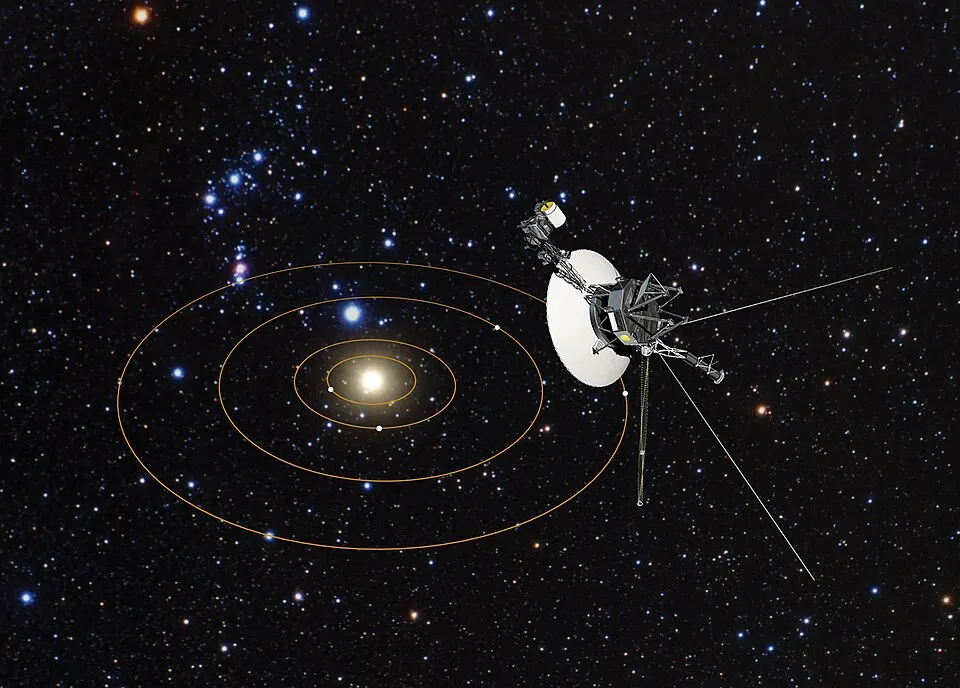
Imagine a beam of light—the fastest entity in the universe, traveling at an incredible 186,000 miles per second—leaving Earth today. It would take a full 24 hours of ceaseless travel across the cold vacuum of space to reach humanity's most distant emissary. On Wednesday, Nov. 18, 2026, NASA’s Voyager 1 probe officially passed this staggering milestone, reaching a distance of exactly one light-day from home. Launched nearly 50 years ago, this hardy traveler has ventured farther into the cosmos than any other object ever crafted by human hands.
For nearly half a century, Voyager 1 has served as our eyes and ears in the remote reaches of space. Now adrift in interstellar space beyond the Sun's heliosphere, the spacecraft is pushing the absolute boundaries of deep-space exploration. Reaching a distance of more than 170 astronomical units from Earth, its ongoing journey remains a profound testament to human curiosity and engineering endurance.
A Legacy Written in the Outer Solar System
Voyager 1 was launched on September 5, 1977, just 16 days after its twin, Voyager 2. Sent initially to explore the outer solar system, the mission forever changed our view of our cosmic neighborhood. Researchers reported that Voyager 1’s legendary photos of Jupiter and its moons fundamentally altered astronomical observations, revealing dynamic, complex worlds where scientists had once expected quiet, cratered spheres.
After completing its grand tour of the outer planets, Voyager 1 kept climbing upward and outward relative to the orbital plane of the planets. Driven by a small nuclear power source, it eventually crossed the heliopause—the boundary where the solar wind gives way to the ambient interstellar medium of high-energy cosmic rays and interstellar gas. Today, it transmits data back from an environment dominated by an ultra-low-density vacuum, dust, magnetic fields, and background radiation cooled near absolute zero.

Communicating Across the Interstellar Void
Maintaining contact with an object a light-day away presents astonishing technical challenges. Scientists rely on NASA's Deep Space Network (DSN), a global array of massive radio antennas, to beam routine commands to the probe and capture its faint whispered responses. Because light and radio waves travel at the same cosmic speed limit, any signal sent to Voyager 1 takes 24 hours to arrive, and engineers must wait another 24 hours to receive a response.
At a distance of one light-day from Earth, a single round-trip radio message between NASA controllers and Voyager 1 now takes a full 48 hours to complete.
The mission's longevity is all the more remarkable given recent technical hurdles. Engineers recently managed to bounce back from a communications glitch in interstellar space, restoring the spacecraft's ability to send valid scientific data back across the immense void. To celebrate the 1-light-day milestone, NASA invited the public and media to join commemorative activities, encouraging space enthusiasts worldwide to shine a light skyward to honor the aging probe's enduring spirit.

The Future of Humanity's Interstellar Emissary
What comes next for Voyager 1 is a quiet, continuous drift into the infinite dark. As its onboard power supplies gradually diminish over the coming years, science instruments will eventually shut down one by one. Yet long after its last radio whisper reaches Earth, Voyager 1 will keep moving through the interstellar void, carrying a message from a small blue world into the unknown.
For scientists and the public alike, Voyager 1 reaching one light-day is more than just a metric of distance. It serves as a haunting mirror of our own place in the universe—a reminder of how far our species has reached, and how vast the silent cosmos remains beyond our shores.
Sources: This report draws on coverage by Live Science, The New York Times Science, The Guardian Science, Space, NASA (.gov), Iowa Now, Down To Earth, Scientific American. The wording is our own.