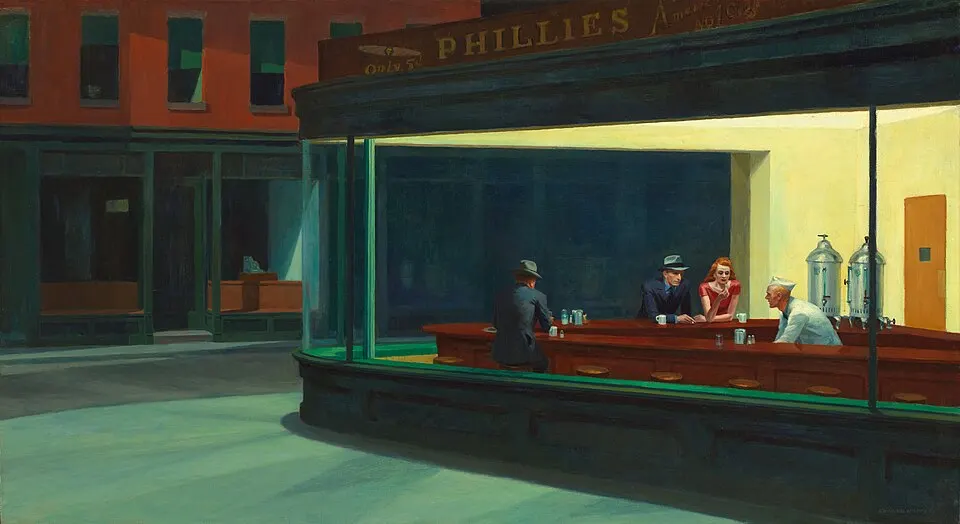
Step through the nocturnal shadows of Manhattan in 1942 and stop outside the curved, seamless glass of a brightly lit downtown diner. Inside, four figures sit under the glaring overhead lights, suspended in an eternal, quiet limbo while the empty, darkened streetscape slumbers around them. Edward Hopper’s Nighthawks is perhaps the most instantly recognizable image of American isolation ever painted—a work so magnetic that a digital video examining its composition can rack up 3.7 million views from audiences still transfixed by its silent drama. Yet behind this cool, cinematic exterior lies a much stormier emotional landscape than the painting’s stillness suggests.
The Maestro of American Realism
Born in Nyack, New York, in 1882, Hopper grew up in a middle-class family that encouraged his early artistic talents. He honed his craft at the New York School of Art under the tutelage of masters like William Merritt Chase and Robert Henri, absorbing an aesthetic that prioritized solitude, light, and shadow. Hopper became a towering figure within American realism—a movement that emerged in literature and visual art to capture the contemporary social realities and daily lives of ordinary citizens. Where earlier generations turned toward pastoral landscapes or gilded portraits, 20th-century American realists aimed to depict a rapidly urbanizing nation with uncompromising fidelity.
Hopper’s genius lay in his ability to transform ordinary urban architecture into psychological stages. Though recognition arrived slowly, by the 1920s his watercolors, etchings, and oil paintings were celebrated across major American museums. In Nighthawks, completed in 1942, his mastery of composition reaches its peak: the harsh light radiating from the diner's interior illuminates the deserted pavement outside, casting long shadows that frame a profound, introspective silence.

Domestic Friction and the Canvas
For all its public acclaim as a commentary on modern city living, Hopper’s work was deeply entangled with his private life. A recent biography has sparked a fresh re-evaluation of the artist, painting a harrowing portrait of his home life in which his wife, the painter Josephine "Jo" Nivison Hopper, reportedly characterized him as a "sadist" and a "prize hog." Jo, an accomplished artist in her own right who had also studied under Robert Henri and won a prestigious Huntington Hartford Foundation fellowship, often posed for her husband’s female figures—including the woman sitting beneath the diner’s fluorescent glow in Nighthawks.
"He is the maestro of American melancholy. But in a new biography, the artist is called a ‘sadist’ and a ‘prize hog’ by his wife – who was aghast to see their domestic and bedroom problems surface."
This domestic psychodrama offers a crucial key to reinterpreting Hopper's output. The severe alienation captured in his canvases was not merely an abstract critique of modern society, but a direct reflection of a troubled household. Jo was horrified to recognize their personal friction and bedroom anxieties playing out publicly on her husband’s canvases, where men and women exist in close physical proximity yet remain emotionally light-years apart.

Why Nighthawks Still Haunts Us
By blending delicate architectural geometry with dramatic light, Hopper fundamentally altered the course of American art. He proved that daily life in a sprawling city could hold the same weight, beauty, and tragic grandeur as historical or classical subjects. His ability to evoke an unwritten narrative through simple form and shadow influenced generations of painters, filmmakers, and photographers.
Nighthawks endures because it articulates a universal human experience: the feeling of being lonely in a crowd, isolated within the very structures built to bring us together. By peering into that illuminated diner, we do not just observe four fictional patrons on a forgotten New York corner; we gaze into the quiet, complex darkness of the human heart.
Sources: This report draws on coverage by The Guardian Art & Design. The wording is our own.