Imagine standing at the edge of the Aegean in 280 BC, your eyes tracing the bronze skin of a titan climbing into the Mediterranean sky. Towering roughly 33 metres (108 feet) above the harbor—two-thirds the height of today’s Statue of Liberty from feet to crown—the sun god Helios caught the dawn long before the city below awoke. To the sailors approaching the Greek island of Rhodes, this was not merely a statue; it was a gleaming defiance cast in metal, a triumph of human scale that defied the horizon itself. Yet today, not a single scrap of its bronze remains, leaving us to chase a phantom that lasted barely half a century before tumbling into myth.
A Titan Born from the Ashes of War
As modern architects re-evaluate the raw power of stone and elemental construction—echoing recent debates over whether rugged, unrefined rock towers could herald a new eco-building age—we are reminded that humanity’s obsession with monumental engineering is thousands of years old. Public fascination with ancient monumental engineering remains strikingly high, as seen in the 2.9 million views racked up by a recent digital exploration into the statue's mystery. We remain transfixed by the sheer audacity of those who dared to build at the absolute limits of contemporary technology.
The story of the Colossus is rooted in a desperate bid for survival. Following the death of Alexander the Great in 323 BC, his empire fragmented into bitter succession wars. The Hellenistic period—an era defined by the expansion of Greek cultural influence across the Aegean and beyond—was born in chaos. In 305 BC, Demetrius I of Macedon, the son of Alexander’s general Antigonus, launched a massive naval and land siege against Rhodes. The islanders held fast, enduring a agonizing year-long assault before Demetrius finally abandoned the siege, leaving behind a fortune in abandoned military engines.
The Rhodians cast their deliverance directly from the melted bronze engines of the defeated invaders, transforming the machinery of destruction into an image of divine light.
To celebrate their miraculous deliverance and honor their patron deity, Helios, the Rhodians sold the abandoned siege gear and commissioned a monument of unheard-of proportions. They turned to Chares of Lindos, a native sculptor of Rhodes and a prized pupil of the legendary master Lysippos. It would take Chares over a decade to complete his masterpiece, finishing the structure around 280 BC. Some historical accounts suggest the final touches may have been completed by Laches, another artisan hailing from Lindos.
The Hellenistic Shift: Drama, Scale, and Bronze
To understand the leap Chares made, one must understand the shift from Classical to Hellenistic art. Where Classical Greek sculpture sought serene balance, mathematical harmony, and ideal restraint, Hellenistic artists embraced emotion, theatricality, dynamic movement, and colossal scale. This was the artistic realm that would eventually yield masterpieces like the Winged Victory of Samothrace, the Laocoön and His Sons, and the Venus de Milo.

Chares took his master Lysippos’s obsession with naturalism and pushed it to an extreme degree. Attributed to Chares was also a colossal bronze head that was later brought to Rome and dedicated on the Capitoline Hill by P. Lentulus Spinther in 57 BC, proving his lifelong mastery of massive facial proportion. For the Colossus itself, the technical demands were staggering. Sculptors of the era utilized the lost-wax technique for bronze casting, but standing a 70-cubit figure upright required an internal structure of iron frameworks and heavy stones to stabilize the shell against the sea winds.
The statue transformed the identity of the island entirely. According to the ancient encyclopedia known as the Suda, the inhabitants of Rhodes came to be called Colossaeans (Κολοσσαεῖς) specifically because they had raised this towering landmark over their shores.
Fifty-Four Years of Glory, Centuries of Memory
The triumph was heartbreakingly brief. In 226 BC, a devastating earthquake struck Rhodes, snapping the giant at its weakest points. The Colossus collapsed, its shattered limbs lying strewn across the earth. The Rhodians considered rebuilding the wonder, but after consulting the famous Oracle of Delphi, they were warned against raising it once more. Out of religious reverence and fear, the broken parts were left untouched where they fell, continuing to awe visitors for centuries as a majestic ruin.
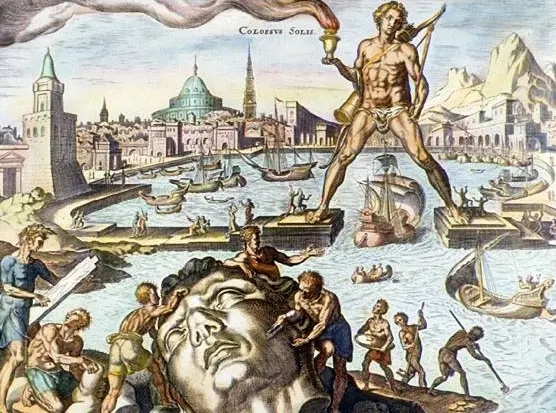
The myth of the Colossus, however, proved impossible to contain. Later historical confusion led writers like John Malalas to claim mistakenly that the Roman Emperor Hadrian had re-erected the statue during his reign. Medieval illuminations and early modern prints began to incorrectly depict the titan straddling the harbor entrance—a structural impossibility for ancient bronze casting—with ships sailing blithely between its legs. When the 1572 publication Octo Mundi Miracula codified the traditional list of the Seven Wonders of the Ancient World, the Colossus took its permanent place alongside the Great Pyramid of Giza, the Lighthouse of Alexandria, and the Hanging Gardens of Babylon.

Why the Lost Colossus Haunts Us Still
Today, of those seven ancient marvels, only the Great Pyramid of Giza remains intact. Traces of the Lighthouse of Alexandria, the Temple of Artemis at Ephesus, and the Mausoleum at Halicarnassus linger in archaeological fragments and museum display cases. But the Colossus of Rhodes left no physical trace. Even the exact location of its original pedestal remains a matter of fierce scholarly debate, despite various proposals put forward since 2008 to erect a modern tribute at Rhodes Harbour.
Yet, in a profound way, the absence of the Colossus only amplifies its power within the history of sculpture. It established the concept that art could be civic theatre on an environmental scale—a monument that redefined a city's skyline and its spirit. When Frédéric-Auguste Bartholdi designed the Statue of Liberty in the 19th century, he was explicitly reaching back across two millennia to Chares of Lindos’s blueprint: a colossal figure of enlightenment guarding a harbor. The bronze may have vanished into the earth, but the ambition of Chares continues to cast its shadow across every sky-scraping monument we dare to build.
Sources: This report draws on coverage by The Guardian Art & Design. The wording is our own.