For decades, the promise of quantum computing has hung like a glittering star just beyond our technological reach. In theory, by harnessing the uncanny behaviors of subatomic physics—where particles exist in multiple states simultaneously through superposition and intertwine across distances via entanglement—these machines could unlock medical treatments, overhaul global logistics, and crack previously impossible physical simulations. Yet, in practice, building a truly useful quantum computer has remained choked by colossal resource requirements and the extreme fragility of quantum states. Now, a profound alliance is emerging at the boundary of computer science: researchers are turning artificial intelligence inward to conquer the very physical and mathematical bottlenecks holding quantum machines back.
Cracking the Resource Wall
The primary barrier to practical quantum computing has always been resources. To perform reliable calculations, quantum systems must constantly fight decoherence and noise, requiring immense overhead just to mitigate errors and keep qubits stable. Over the past several days, a wave of research has demonstrated that AI can dramatically trim these requirements.
In a landmark collaboration, researchers from Harvard, Anthropic, and QuEra published breakthrough research uniquely showing that AI models can reduce the physical and algorithmic resources quantum applications need. By letting machine learning assist in architecting quantum processes, the team demonstrated a way to significantly accelerate the timeline for bringing useful quantum computing into reality. Meanwhile, Google researchers—working across Google DeepMind and Google Quantum AI—reported using AI and formal mathematical proofs to discover optimized quantum algorithms. Utilizing the Lean 4 proof assistant, the team discovered formally verified quantum algorithms that directly cut down computational requirements.
"Breakthrough research uniquely shows AI can reduce the resources quantum applications need, significantly accelerating the era of useful quantum computing."
Solving Decades-Old Puzzles in Hours
The convergence of machine intelligence and quantum theory is also delivering astonishing results on the theoretical front, where long-standing mathematical conjectures have stymied physicists for years. AI systems are moving beyond simple pattern recognition to settle foundational questions about computational complexity theory—the branch of mathematics that classifies problems by the resources needed to solve them.
Researchers reported that an AI system at PSI tackled an 18-year-old quantum computing puzzle, settling the longstanding quantum conjecture in just 72 hours. In parallel, another AI-assisted proof settled a fundamental question about quantum speedups, helping map the precise boundaries where quantum computers actually gain an edge over classical supercomputers. By proving the limits and capabilities of quantum systems mathematically, these breakthroughs allow scientists to bypass theoretical dead ends and focus engineering efforts strictly on applications where a true quantum advantage exists.
From Theory to the Data Center
This theoretical progress is rapidly translating into industrial software and hardware deployment, drawing massive capital and institutional backing. The push to make quantum systems usable in the real world is taking several distinct paths:
- Software-Driven Error Control: Q-CTRL recently secured $290 million in Series C funding to scale its AI-driven software, designed to optimize quantum control and accelerate the convergence of quantum and AI architectures.
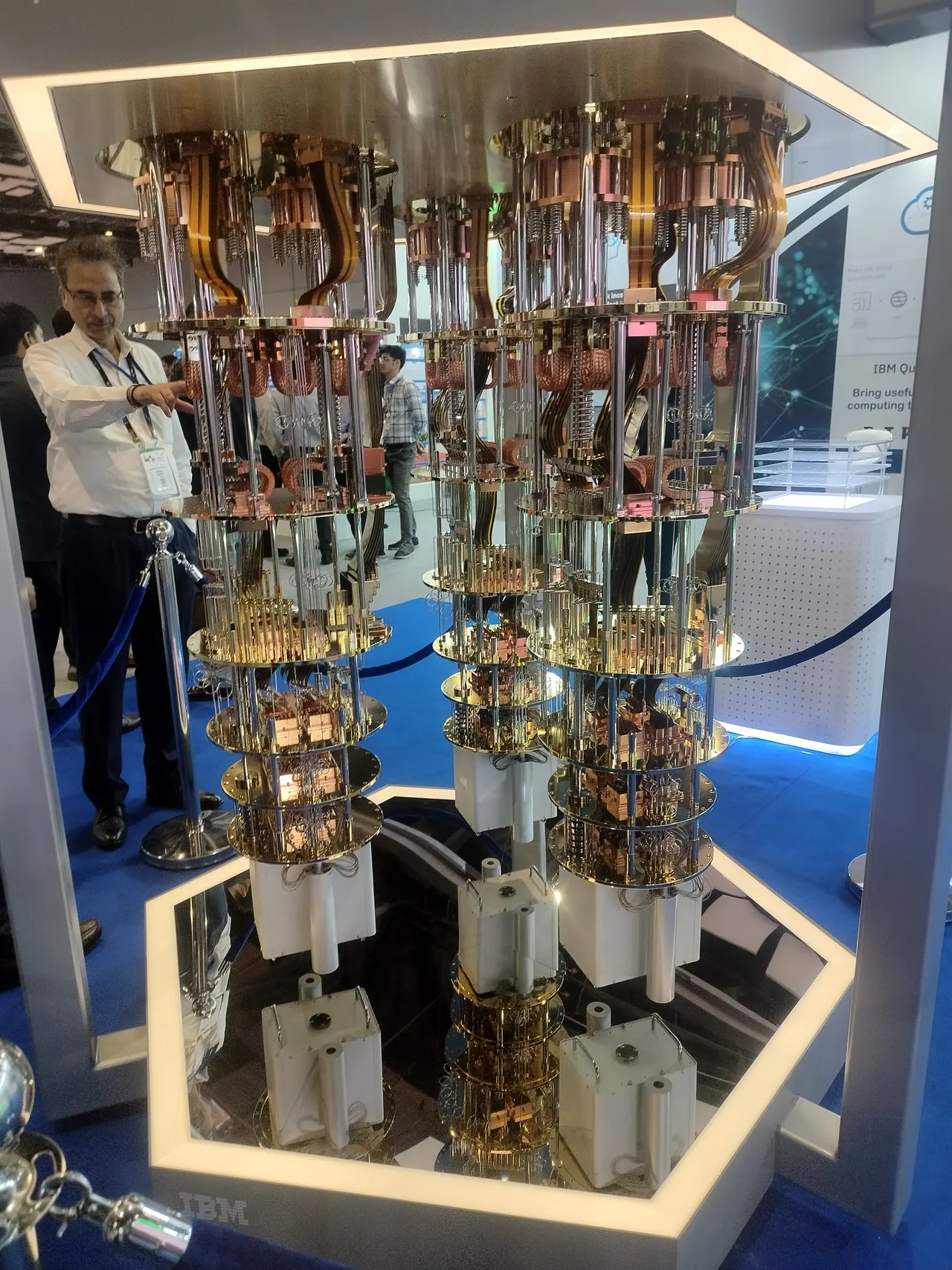
- Catalog Integrations: LTM brought AI-powered quantum error mitigation directly to the IBM Quantum Functions Catalog, making advanced error suppression accessible within standard cloud-based quantum workflows.
- Targeted Problem Mapping: A recent study mapped 24 specific problem domains where quantum computers could realistically gain an operational edge, giving developers a clear roadmap for deployment.
- Educational Accelerators: Initiatives like the IBM Impact Accelerator are bringing combined AI and quantum tools to the future of work and learning, preparing the next generation of engineers.
The Horizon of Useful Quantum Machines
As AI settles theoretical limits and slashes software overhead, the broader technological landscape is preparing for the eventual arrival of fault-tolerant quantum hardware. The implications extend far beyond academic labs. The potential disruption to traditional cryptography has already prompted sector-wide moves; for example, Ethlabs recently prioritized Ethereum's quantum defenses ahead of execution speed, responding to industry warnings that full-scale quantum systems represent a transformative shift for digital security.
We are witnessing a symbiotic evolution. AI models are acting as hyper-efficient mathematicians and software engineers, discovering formally verified algorithms and solving resource-heavy conjectures in days rather than decades. In return, they are laying the groundwork for the very quantum machines that may one day power the next generation of artificial intelligence. By using today's smartest algorithms to tame the chaotic world of the subatomic, science is finally clearing the path toward useful, accessible quantum power.
Sources: This report draws on coverage by The Quantum Insider, PR Newswire, Brief IA, Sri Lanka Guardian, Traders Union, Quantum Computing Report, Quantum Zeitgeist, Yahoo Finance. The wording is our own.