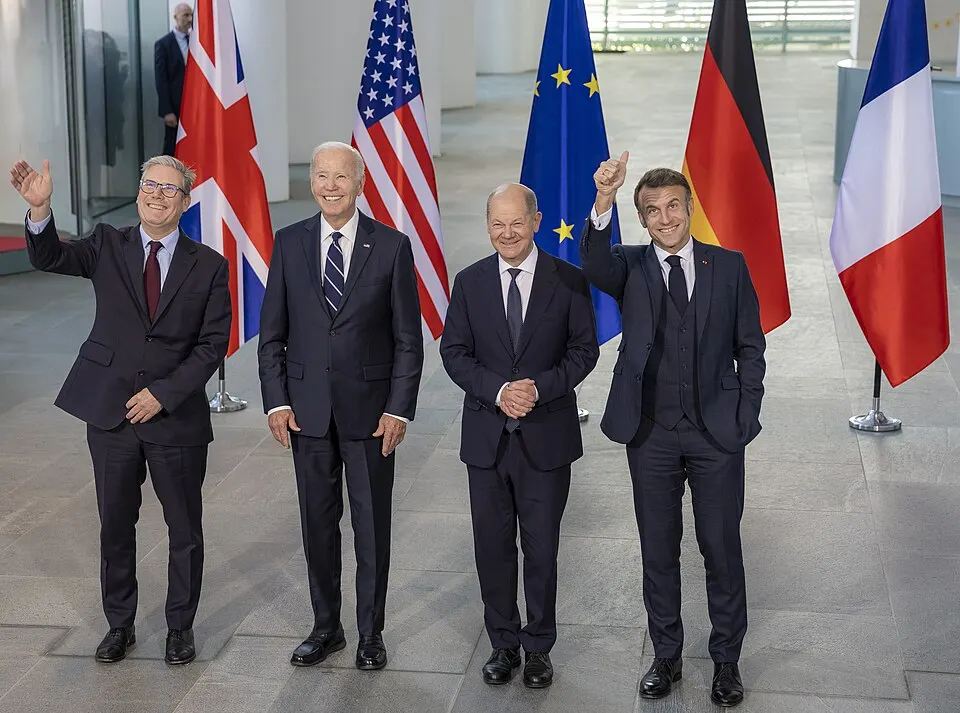
More than 40 European leaders and top Western officials assembled in Berlin for an emergency Coalition of the Willing summit to establish a unified European negotiating position on the war in Ukraine, following trilateral talks between U.S. President Donald Trump, Russian President Vladimir Putin, and Chinese President Xi Jinping in Shenzhen, China. Convening alongside Ukrainian President Volodymyr Zelensky, European heads of state insisted that no diplomatic resolution regarding European security or Ukrainian sovereignty can occur without their direct involvement, pushing back against potential bilateral deals struck between Washington and Moscow.
Why did European leaders convene an emergency summit in Berlin?
European leaders convened in Berlin to prevent a secret bilateral arrangement between the United States and Russia that could decide Ukraine's territorial integrity and European security architecture over their heads. Speaking at the summit, German Chancellor Friedrich Merz explicitly rejected any diplomacy resembling the post-World War II division of influence, stating, "a Yalta format will not bring about peace." Merz presented attending delegates with a historic fragment of the Berlin Wall to symbolize the dangers of past European divisions and urged the Russian leadership to end its war of aggression so diplomatic solutions could proceed.
UK Prime Minister Andy Burnham echoed the need for European unity, asserting that the continent maintains a clear, consistent, and joint posture regarding upcoming talks. The European consensus stresses that negotiations can succeed only if Kyiv and its continental allies participate simultaneously. Leaders affirmed their commitment to support Ukraine for as long as necessary, while maintaining that Russia's maximalist conditions remain completely unviable for a lasting peace agreement.
What occurred during Donald Trump's trilateral talks in Shenzhen?
The Berlin assembly directly followed a high-profile diplomatic encounter in Shenzhen, south-eastern China, where U.S. President Donald Trump met with Russian President Vladimir Putin and Chinese President Xi Jinping during the Asia-Pacific Economic Cooperation (APEC) framework. Following the Shenzhen meetings, Trump called into the Berlin conference from Air Force One while traveling back to Washington. According to European officials briefed on the conversation, Trump strongly pressed European allies regarding the heavy financial burden of military aid and cash assistance to Kyiv, arguing that concluding the war rapidly would save both lives and financial resources that could be redirected toward domestic spending and national defenses.
White House representatives and U.S. officials later clarified the tone of the call, denying assertions that Trump demanded an immediate end to European military aid. Instead, U.S. officials stated the president was expressing optimism about peace prospects while highlighting the immense economic and human costs of the conflict. Senior U.S. peace envoys Steve Witkoff and Jared Kushner attended the Berlin summit in person to brief European allies and Ukrainian officials on the outcome of the Shenzhen discussions.
Is Russia open to NATO-style security guarantees for Ukraine?
Speaking to reporters in Berlin, U.S. envoy Jared Kushner stated that U.S. negotiators had persuaded the Kremlin to accept a multilateral dialogue format that includes European nations. Furthermore, Kushner claimed that Russian negotiators appear comfortable with providing Ukraine with postwar security guarantees modeled on NATO's Article 5 collective defense principles. According to Kushner, U.S. envoys proposed these security assurances after receiving authorization from Trump, arguing such measures were essential for any long-term peace framework.
"Most importantly, Russia has agreed to its involvement in a multilateral format with the Europeans, because we have explained to the Russians that Europe is an essential actor," U.S. envoy Jared Kushner told reporters in Berlin.
Despite Kushner's optimistic assessment, significant skepticism remains regarding Moscow's true willingness to accept Western-backed collective defense commitments for Kyiv. Moscow has historically rejected any NATO affiliation or equivalent military integration for Ukraine. Ukrainian President Volodymyr Zelensky noted that the Russian leadership has repeatedly turned down peace terms, pointing out that "Putin has always said no" to previous diplomatic efforts.
How did Vladimir Putin react to European participation?
During a lengthier press conference in Shenzhen following his meeting with Trump and Xi, Russian President Vladimir Putin offered a mixed assessment of potential European involvement in peace negotiations. Putin confirmed that American envoys had insistently requested that European representatives be included at the negotiating table. While claiming Russia was not fundamentally opposed to European inclusion, Putin questioned what constructive proposals European governments would actually bring to the discussions.

Putin suggested that European representatives visit Moscow through official diplomatic channels to clarify their specific negotiating positions before any permanent multilateral conference structure is finalized. The Russian leader accused European states of escalating rhetoric by frequently warning their publics of a potential military clash with Russia by 2030, denying any intentions of attacking European nations. However, Putin conceded that attempting to negotiate comprehensive security arrangements for the European continent without involving European powers would ultimately be pointless.
What is the background of the conflict and diplomatic efforts?
The diplomatic maneuvering in Berlin and Shenzhen occurs against the backdrop of the full-scale Russian invasion of Ukraine launched in February 2022. Ukraine, an Eastern European country covering roughly 603,628 square kilometers with a population of approximately 32 million, has relied heavily on financial and military assistance from Western nations to defend its territory against Russia, the world's largest nation by land area.
Germany's capital city of Berlin, which was historically divided during the Cold War following agreements made by Allied leaders at the Yalta Conference in 1945, served as a symbolic location for the European summit. European heads of state leveraged this historic context to emphasize that modern European borders and security arrangements cannot be rewritten by external powers. Meanwhile, Ukrainian President Volodymyr Zelensky held targeted discussions with American envoys Steve Witkoff and Jared Kushner to establish the specific timeline, format, and structure for upcoming peace negotiations.
What remains unclear about the next phase of peace negotiations?
Critical details regarding the structure, location, and timing of potential multi-party negotiations remain unresolved following the Berlin meetings. The primary unresolved questions center on the following key issues:
First, it remains unconfirmed whether Moscow will officially accept European delegates into a direct four-party negotiating format alongside the United States, Russia, and Ukraine. While American envoys reported Russian flexibility, Vladimir Putin's demand for European diplomats to travel to Moscow first indicates that the formal meeting format is far from settled.
Second, the exact scope of proposed security guarantees for Ukraine has not been codified. It is unclear how an Article 5-style mechanism would function for a non-NATO member, or whether Russia would demand substantial territorial concessions from Kyiv in exchange for agreeing to such guarantees.
Finally, European leaders and Ukrainian officials have not publicly agreed to any reductions in military aid or financial support. Ukrainian President Volodymyr Zelensky stated he expects the upcoming round of peace talks to transition into a direct four-way format, though no concrete dates or host cities have been officially announced by the participating governments.
Sources: This report draws on coverage by The Guardian, POLITICO.eu, NewsCord, BBC News, DW.com, AFP.com, San Luis Obispo Tribune, Al Arabiya English. The wording is our own.