
A white porcelain vase with six pale roses stands by a window at dusk. Each time the camera comes back to it, the crack in its side has run a little further. Nobody touches it. Before the song's three minutes and fifty-eight seconds are over, it comes apart on its own.
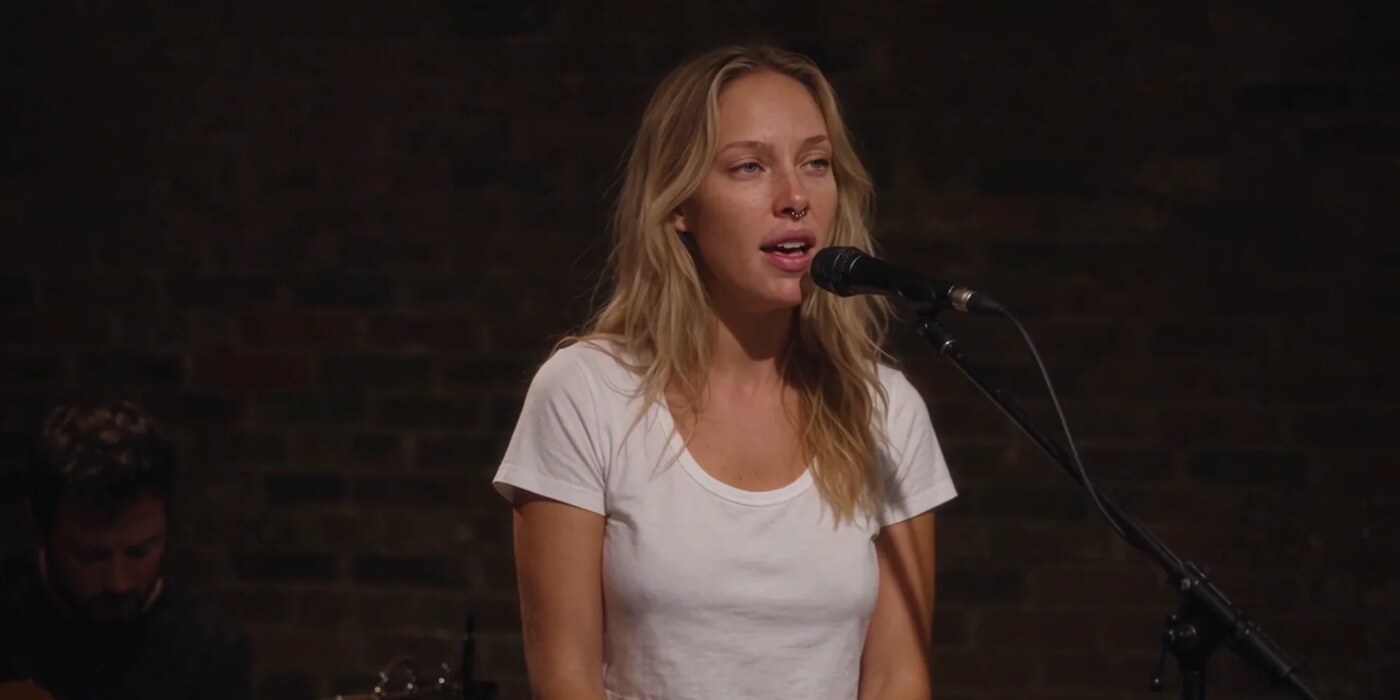
In between, a woman with freckles across her nose and a small silver ring in her septum sings into a single microphone, one hand on her headphones, eyes half closed. She does not smile. She never does when she sings; it is written into her rules.
The song is Porcelain, the singer is Mila Zima, and neither the woman nor the room exists. Mila Zima is an AI pop star, and her own site says so before it says anything else: “Her face, her voice and the rooms she sings in are generated. The decisions are made by people.”
One song, released twice
Porcelain went up on her YouTube channel on 15 November as an official music video. Two days later came an acoustic version: the same song with one guitar, filmed in a small, dim bar with a handful of listeners in the dark. The style is soul-pop with a rock edge at 107.7 beats a minute, close and unhurried in the verses and raw on the hook.
The numbers are still small. In its first four days the official video was watched about 4,600 times, and the acoustic film a few hundred. This is not a chart story yet. It is a story about a pop act being built in the open, and about a choice most AI music has avoided: telling the listener everything.
Twenty-seven, and staying that way
On paper Mila Zima is a singer of twenty-seven. In the words of her own site, “she has been twenty-seven since the day she was drawn.” She is about 175 cm tall, with long, wavy dark-blonde hair that has copper in it and blue-grey eyes. Her skin is light, with dense freckles across the nose and cheeks, and by rule it is “never smoothed, never polished.”

Nothing about her is offered as real. Her story is written in chapters, and above it sits one plain sentence: “None of it took place.”
How a generated singer is kept the same
The hard problem with a synthetic performer is not making one striking picture. It is making the same woman twice. Mila's makers drew one face in November, locked it the same week, and now work from the same seven reference pictures, five views of her face and two of her build, for every image. Each frame is then measured against the locked face. A calm, front-on shot has to score 0.60; a face with an expression, 0.47. For scale, the site reports that 34 photographs of other women scored no higher than 0.17.

The voice was generated once, in Suno, and kept; she sings every song with it. The song itself was generated more than once, and a person, referred to throughout only as “the director”, picked the take by ear. That division of labour runs through the whole project. “The agent that builds the film cannot watch it or hear it,” the production record states. “It works from frames and measurements.” The song's own page gives its key as F minor “by measurement”, with a caveat: “not verified by ear.”
A $177 music video
The first film took 13 hours and 45 minutes from the first take to the last. The team generated 175 takes, most of them five or ten seconds long, and cut 56 shots from them. Six video models were tried. “One carried the film,” the record says; “a second one broke the vase.” Wan 3.0 accounts for 160 of the takes. All of them together cost $177.25, and only $55.12 of that is on screen. The 106 scene stills behind them cost $10.57.
On the morning of 14 November the director watched six cuts, one after another, and answered each with notes that read like any edit-suite argument. “The engineer shot looks like AI stock,” says one. By the last cut the control room had been taken out of the film altogether. Then came the note that locked it: “It has its flaws. It is the first film, so it stays as it is.”

The list of what is wrong
Most releases hide their seams. This one numbers them. The Porcelain page ends with eleven known flaws, numbered one by one. Between the street and the taxi her purse changes hands. When the vase bursts, “the water keeps the shape of the vase for a moment, like glass.” At 1:35 two rose heads drop, although the number of flowers was meant to stay the same. And in the long wordless rise between 1:45 and 1:51 her mouth nearly closes while the voice is at full strength, a fault whose cause the team says it never pinned down.
The acoustic film, made from 179 takes that cost $113.03, has twelve. It also shows the makers learning. On long high notes generated lips do not hold to the voice, so those seconds were filmed from behind, on the listeners, or in slow motion. Even so, the record counts the result: in the 124 seconds where she sings and her lips can be read, they sit on the voice in 99. The guitarist's fretting hand is never shown close, because “a generated hand cannot be matched to the notes of a real recording.” The flaws are listed, both pages say, “so that the next one starts from them.”
Why the label matters now
The timing is not incidental. Deezer says fully AI-generated tracks made up more than half of all daily uploads to its service at their peak in June, close to 90,000 a day. On 17 November, two days after Porcelain came out, the streaming company published its second annual survey with Ipsos, covering 9,000 people in eight countries. Eighty per cent said both fully AI-generated and AI-assisted music should be clearly labelled. Nearly three quarters of streaming users believed their playlists were free of fully AI-generated tracks; Deezer's own data on more than 53,000 new subscribers showed that about 57% already had at least one. A year earlier, in the first edition of the survey, 97% of listeners could not tell AI tracks from human ones in a blind test.
The acts that have broken through so far arrived with less candour. The Velvet Sundown had more than 900,000 monthly listeners on Spotify in July 2025 when its biography was rewritten to describe “a synthetic music project”. Xania Monet, created by the Mississippi poet Telisha Jones with the same Suno software, became the first known AI artist to debut on a Billboard radio chart and signed a multimillion-dollar deal with Hallwood Media; CBS News reported that some fans were shocked to learn she was a product of artificial intelligence.
Mila Zima starts from the opposite end. Her published rules say she will not pretend to be a human being, will not borrow a real person's face, name or voice, will not wear a logo, will not appear undressed and will not “be framed as one part of her body.”
What the openness does not settle
Disclosure answers one question, not all of them. The people who make the decisions are not named anywhere on the site. Her voice comes from Suno, a company the major record labels sued for copyright infringement in 2024, and an honest label does not resolve the wider argument over what such tools were trained on. In this month's Deezer survey, 69% of respondents said fully AI-generated music threatens the livelihood of artists. And a production record, however exact, cannot decide whether a song is worth hearing twice. Listeners decide that, and so far there are a few thousand of them.
What comes next
The site promises that every song will get the same page as Porcelain: the song, the film and how both were made. The director's last note on the acoustic film reads: “We should take lessons from this one and from the first film.” Besides YouTube, she is on Instagram, TikTok and X under the same handle, @milazimacom, and the full record is at milazima.com.
The next film starts from two lists: eleven known flaws in the first and twelve in the second.
Porcelain in numbers
- 3:58 — length of the song, at 107.7 beats a minute.
- 175 takes, 56 shots — what was generated for the first film and what was kept.
- 13 hours 45 minutes — from the first take to the last.
- $177.25 — spent on video takes; $55.12 of it is in the finished film.
- 11 and 12 — known flaws listed for the first film and for the acoustic version.
Disclosure: Mila Zima and AMK News share an owner. No payment was made for this article. The figures about the project were taken from its public record at milazima.com and from its YouTube channel on 19 November 2026. The images are AI-generated and are reproduced from the project's site.
Sources: This report draws on the public record at milazima.com (fact sheet, Story, Porcelain, Porcelain Acoustic and Stages pages) and the Mila Zima YouTube channel; Deezer and Ipsos (17 November 2026); Deezer and Ipsos (2025); TechCrunch; Rolling Stone; Billboard; CBS News. The wording is our own.