On November 14, 1969, NASA launched Apollo 12 from the Kennedy Space Center in Florida, marking the second time humans embarked on a mission to reach the lunar surface. Commanded by Charles "Pete" Conrad, with Lunar Module Pilot Alan L. Bean and Command Module Pilot Richard F. Gordon, the all-Navy crew successfully navigated the hazards of a stormy liftoff to reach the Moon. Their mission, which lasted from November 14 to November 24, 1969, demonstrated that NASA could perform pinpoint landings, ultimately securing the agency's ability to explore specific, scientifically significant sites on the lunar terrain.
Why was the launch of Apollo 12 particularly perilous?
The launch of Apollo 12 occurred on a rainy day at the Kennedy Space Center, and shortly after liftoff, the spacecraft was twice struck by lightning. These strikes caused significant instrumentation problems that threatened the integrity of the mission. By switching to the auxiliary power supply, the crew managed to resolve the data relay issues, effectively saving the mission from an early failure. Despite the dramatic start, the outward journey to the Moon remained relatively stable, allowing the mission to proceed toward its destination in the Ocean of Storms.
How did the crew achieve a historic pinpoint landing?
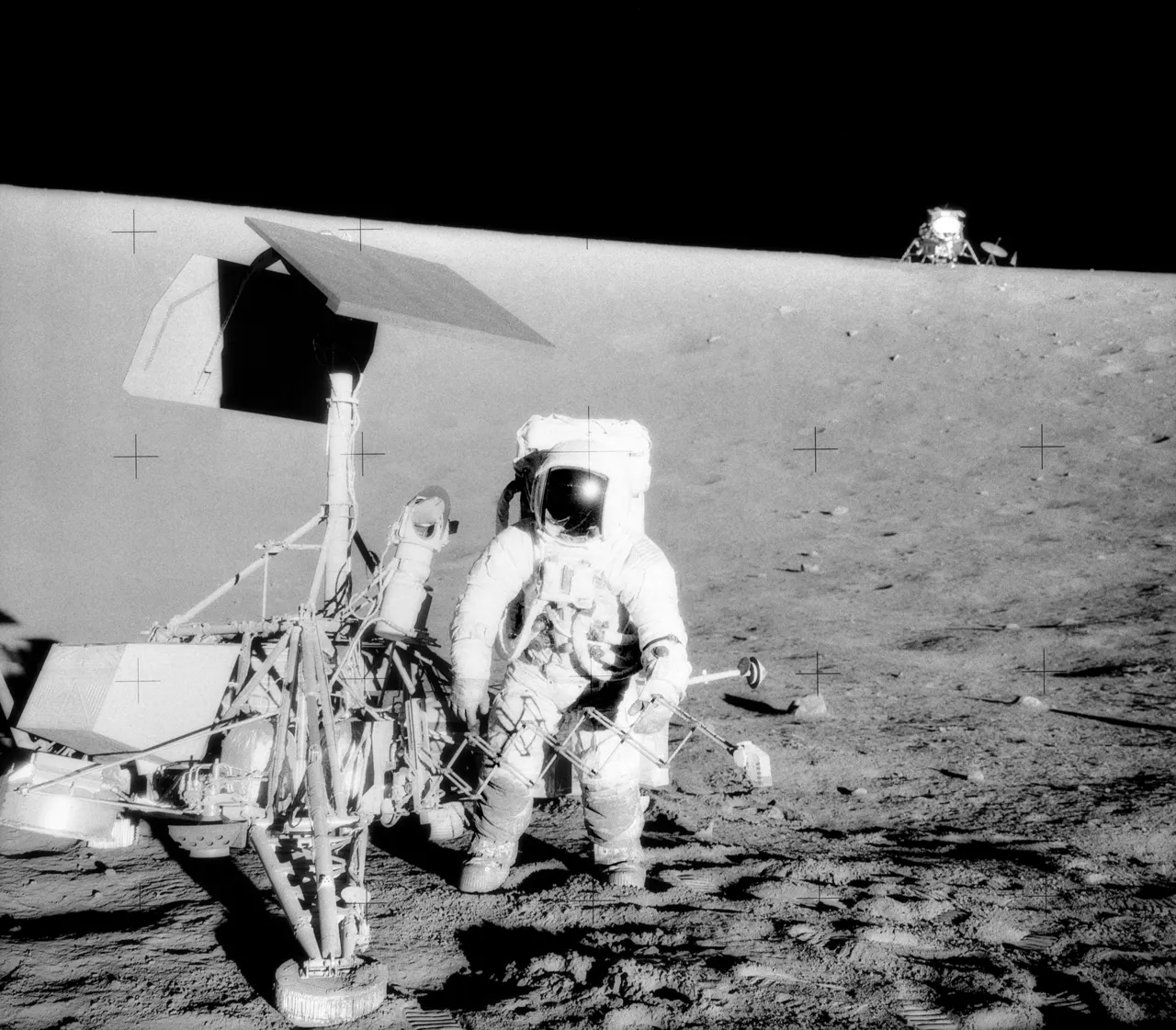
The mission to land Apollo 12 near the Surveyor 3 robotic probe was considered a bold risk by many within NASA. Because Apollo 11 had landed several miles off-target, many administrators feared that attempting a landing within walking distance of the 1967 probe would result in an embarrassing miss. However, through the diligent study of lunar imagery—where expert Ewen Whitaker identified specific rock formations near the crater—the crew successfully landed the Lunar Module Intrepid exactly where intended. This accomplishment proved that future missions could reliably reach specific scientific points of interest, rather than simply landing in broad, safe areas.

The successful landing of Apollo 12 within walking distance of the Surveyor 3 probe, which had touched down on April 20, 1967, demonstrated that NASA could plan future missions for specific scientific targets.
What did the astronauts accomplish on the lunar surface?
Once on the Moon, Commander Charles "Pete" Conrad and Lunar Module Pilot Alan L. Bean completed just over one day and seven hours of activity on the lunar surface. They deployed the Apollo Lunar Surface Experiments Package, a collection of nuclear-powered scientific instruments, to gather data on the lunar environment. During their second moonwalk, they reached the Surveyor 3 probe, cutting away parts to return to Earth for analysis. While they brought the first color television camera to the lunar surface, the transmission was cut short when Bean accidentally pointed the device directly at the Sun, burning out its sensor.
The training for this mission was the most rigorous in the Apollo program, with each crew member logging over 1,000 hours of mission-specific preparation. Conrad and Bean spent over 400 hours each in simulators to ensure they could handle the descent and surface operations. This dedication to preparation was bolstered by their experience as the backup crew for Apollo 9, providing them with a deep understanding of the spacecraft systems and flight protocols required for success.

The crew of Apollo 12 represented a close-knit group of experienced naval aviators. Charles "Pete" Conrad had previously flown on Gemini 5 and Gemini 11, and he specifically requested Alan L. Bean to join him after the tragic death of the original lunar module pilot, Clifton C. Williams Jr. Richard F. Gordon, who remained in lunar orbit during the surface activities, also shared a history with Conrad from their time together on Gemini 11. This shared history and professional rapport were vital to maintaining composure during the challenges posed by the launch and the mission itself.
As the mission progressed, the support crews played a crucial role in maintaining the integrity of the flight plan. The support team, including Gerald P. Carr, Edward G. Gibson, and Paul J. Weitz, were responsible for updating checklists and rules, ensuring that the primary crew could focus on their complex tasks on the lunar surface. The flight directors, including Gerry Griffin, Pete Frank, Clifford E. Charlesworth, and Milton Windler, held the ultimate responsibility for ensuring crew safety throughout the duration of the flight.

The return journey was seamless, with the Lunar Module Intrepid lifting off from the Moon on November 20 to dock with the command module. After the spacecraft returned to Earth, the mission concluded on November 24 with a successful splashdown. This mission was instrumental in transitioning the Apollo program from a primary goal of proving lunar arrival to a robust program of scientific exploration.
Apollo 12 was the only all-Navy crew to fly during the Apollo program.

The crew visited the Surveyor 3 probe, which had been sitting on the lunar surface for over two and a half years before they arrived.
The mission had a set of hammocks added to the Lunar Module to provide the astronauts with a more comfortable resting arrangement while on the Moon.
Watch: Apollo 12: The Pinpoint Mission
From the NASA channel.
Sources and further reading: Wikipedia — Apollo 12, Apollo program, NASA, Space exploration (CC BY-SA). Images: Wikimedia Commons.