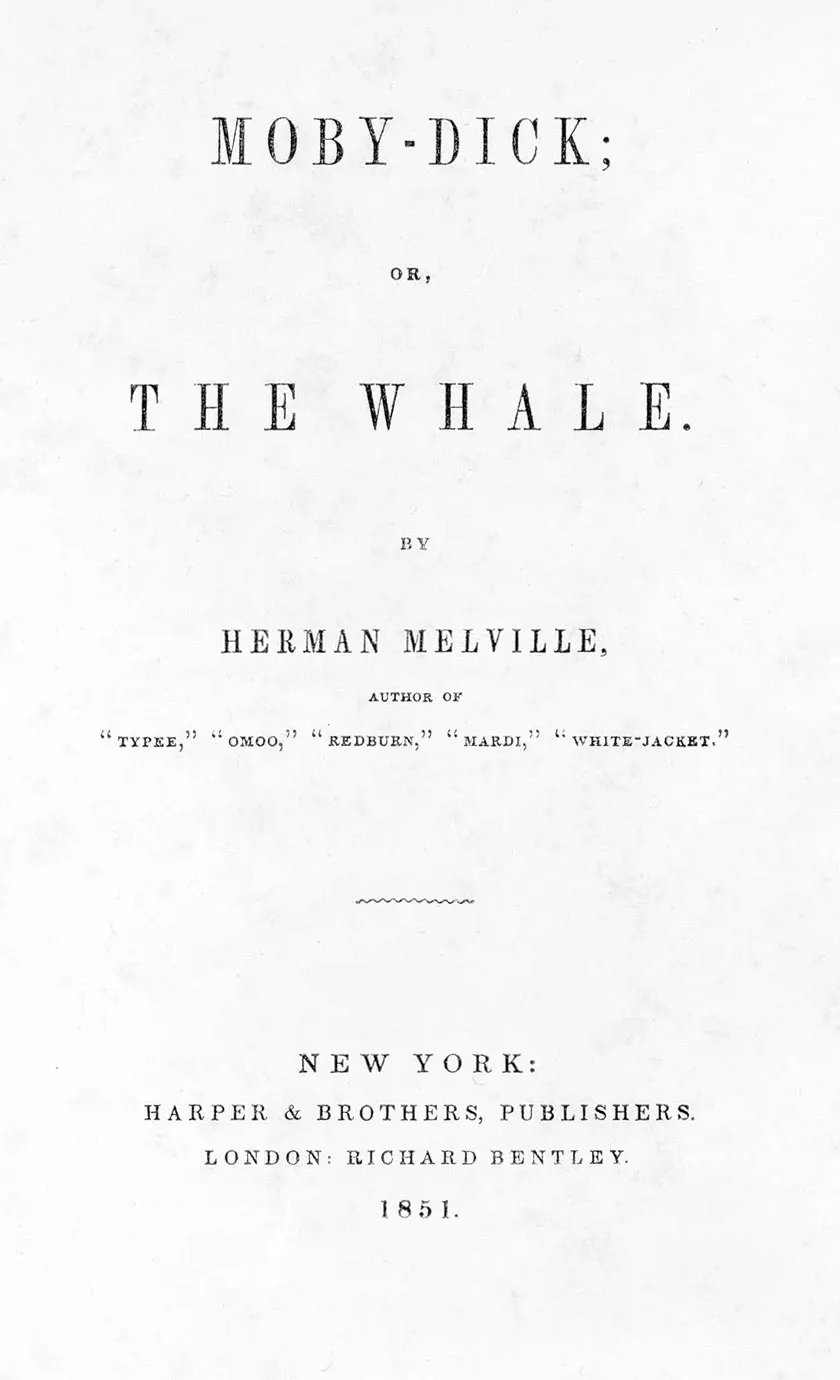
On November 14, 1851, the American writer Herman Melville published his sixth novel, Moby-Dick; or, The Whale, in the United States. Released as a single-volume edition by Harper & Brothers in New York, the book introduced the world to the maniacal Captain Ahab, the narrator Ishmael, and the titular white sperm whale. Though it is now celebrated as one of the greatest novels ever written, its initial reception was a failure that nearly sank Melville's literary career.
The journey to the book's American release was long and arduous. Melville began writing the manuscript in February 1850, drawing heavily on his personal experiences as a common sailor aboard whaling ships from 1841 to 1844. What began as a realistic adventure story evolved into a sprawling, metaphysical epic after Melville met Nathaniel Hawthorne in August 1850. Deeply impressed by Hawthorne’s "cosmic ambitions," Melville spent eighteen months revising and deepening the text, eventually dedicating the masterpiece to Hawthorne in a show of profound admiration.
While a three-volume edition titled The Whale had appeared in London just weeks earlier in October 1851, the November 14 American release represented Melville's definitive vision. The New York edition restored the title to Moby-Dick and included the vital epilogue explaining Ishmael's survival—a component missing from the British version. This American publication featured a diverse cast of characters, including the Polynesian prince Queequeg and the Quaker mate Starbuck, reflecting the multicultural reality of the 19th-century maritime industry.

What inspired the story of the Great White Whale?
Herman Melville constructed his narrative from a mixture of historical fact and personal trauma. The character of Moby Dick was modeled on a real, notoriously aggressive albino sperm whale known to sailors as Mocha Dick. Furthermore, the catastrophic ending of the novel, in which the whale destroys the ship, was inspired by the 1820 sinking of the whaleship Essex. Melville’s detailed descriptions of cetology and the processing of whale oil were not merely flourishes; they were grounded in his years at sea, where he witnessed the brutal reality of the hunt firsthand.
The opening sentence of the novel, "Call me Ishmael," has become one of the most famous and recognizable lines in the history of world literature.
The structure of the novel remains one of its most fascinating aspects. Melville utilized an array of literary devices including Shakespearean soliloquies, stage directions, poetry, and catalogs of whale anatomy. He split the narrative between the younger "forecastle Ishmael" who experiences the voyage and the older narrator Ishmael who reflects upon it. This complex layering of voices allowed Melville to explore deep philosophical questions regarding class, the existence of God, and the struggle between good and evil.

Why was Moby-Dick initially considered a failure?
Moby-Dick faced a hostile reception from American critics who were baffled by its experimental style and dark themes. Unlike Melville's earlier romanticized accounts of Polynesian life, such as Typee, this new work was dense and demanding. The book was a commercial disappointment, and as the years passed, it fell out of print. By the time Herman Melville died in 1891, he was largely forgotten by the public, and his greatest achievement was regarded as a literary curiosity rather than a masterpiece.
The novel's reputation was only rescued in the 20th century. The 1919 centennial of Melville's birth sparked a massive "Melville Revival," as scholars and writers began to recognize the book's modern sensibilities. Literary giants like William Faulkner expressed envy of Melville’s achievement, and D. H. Lawrence lauded it as "one of the strangest and most wonderful books in the world." It was during this era that the novel finally claimed its title as the "Great American Novel."

How does the plot mirror Melville's philosophical obsessions?
Herman Melville used the Pequod’s journey from Nantucket through the Indian Ocean as a laboratory for human nature. The conflict between the pragmatic Starbuck and the vengeful Ahab illustrates the tension between reason and obsession. As Ahab nails a doubloon to the mast as a prize for the first man to sight his nemesis, he forces his crew to abandon their profit-seeking mission for his private vendetta. This descent into madness is punctuated by omens, from the prophecies of the madman Elijah to the appearance of the Parsee Fedallah, Ahab’s secret harpooneer.
D. H. Lawrence called Moby-Dick "the greatest book of the sea ever written" and praised its unique, haunting atmosphere.
The climax of the novel occurs over a three-day chase that fulfills every dark prophecy laid out in the text. Moby Dick destroys the whaleboats and eventually the Pequod itself—the "hearse of American wood" predicted by Fedallah. In a final, gruesome image of entanglement, Ahab is dragged into the depths by his own harpoon line. Only Ishmael is left to tell the tale, saved by the buoyancy of Queequeg’s empty coffin, which serves as a life buoy until the ship Rachel rescues him.

Today, Moby-Dick stands as a monument of the American Renaissance, studied for its intricate symbolism and its bold, experimental prose. The date of November 14 remains a milestone in publishing history, marking the moment a struggling author offered the world a vision of the sea that was as vast and terrifying as the human soul itself. While Melville did not live to see its success, his work eventually achieved the immortality he had sought through his writing.
Did you know? The original British edition of the book was missing the epilogue, leading some confused reviewers to wonder how Ishmael could tell the story if he had died with the rest of the crew.
Did you know? Herman Melville's inspiration, the white whale Mocha Dick, was a real animal that survived dozens of encounters with whalers before finally being killed.
Watch: Herman Melville, Moby Dick, first edition, 1851. Peter Harrington Rare Books.
From the PeterHarringtonBooks channel.
Sources and further reading: Wikipedia — Moby-Dick, Herman Melville (CC BY-SA). Images: Wikimedia Commons.