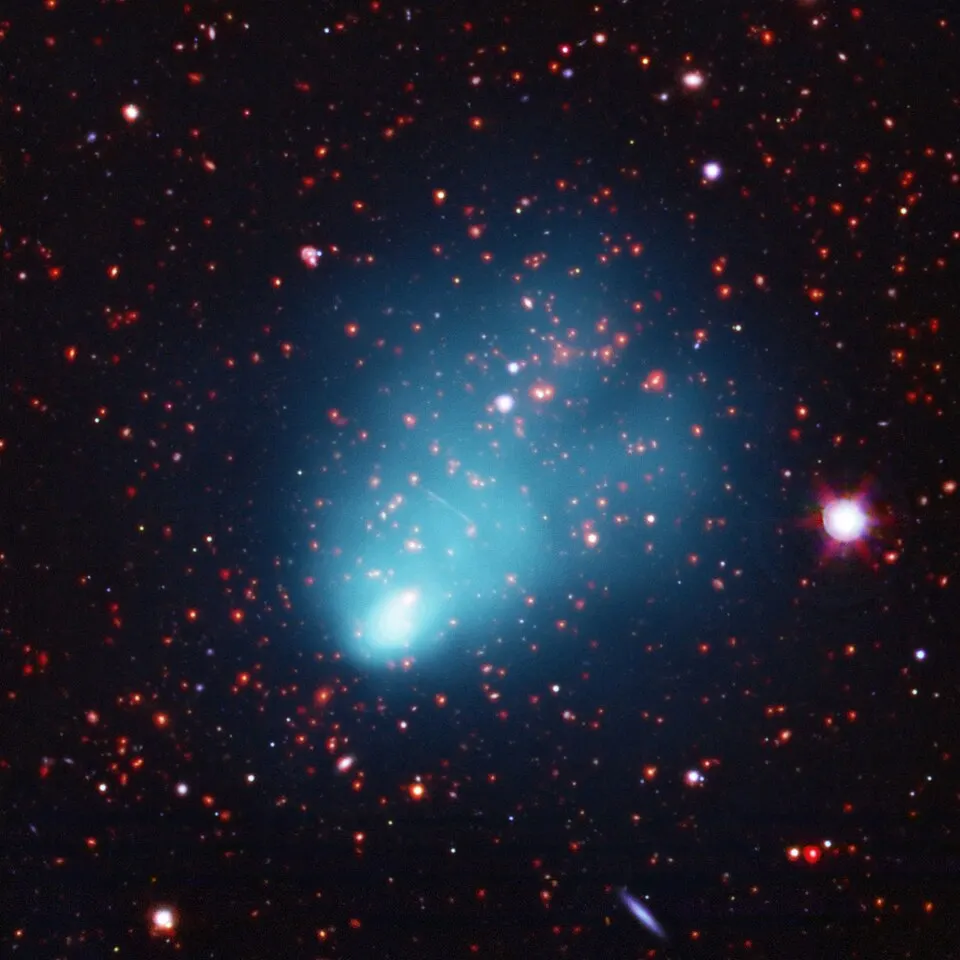
The question of who discovered dark matter is deceptively brief, but its answer is complex. There is no single particle caught in a lab experiment; instead, the evidence rests on observations made at vastly different scales over many years, ranging from galaxy clusters and individual galaxies to the cosmic microwave background. When these three scales are examined together, they reveal a mass component significantly larger than that of visible matter.1
Who discovered dark matter?
In the public imagination, one name is often highlighted, but the discovery of dark matter was a gradual, incremental process. First, researchers identified a dynamic discrepancy within galaxy clusters; subsequently, the same signature was confirmed in individual galaxies; and finally, calculations of the universal mass budget validated this phenomenon on a global scale. Therefore, the answer is not a single individual, but rather the convergence of successive, consistent measurements.
What was the first evidence of dark matter?
The first turning point occurred in 1933. The Swiss astronomer Fritz Zwicky measured the velocities of galaxies within the Coma cluster and calculated the total mass using the virial theorem. The result was significantly larger than expected. The visible amount of stars and gas was insufficient to hold such a rapidly moving system together. Zwicky coined the term "dunkle Materie" to describe this missing mass.2 While the conclusion was stark for that time, the methodology was clear: if there is motion, there must be mass, and if the mass is invisible, something is missing.
This observation remained on the periphery for a long time. Data were scarce, error margins were high, and many astronomers approached the finding with caution. Nevertheless, it marked the essential historical threshold for the field.
Notes and Sources
- J. Binney and S. Tremaine, Galactic Dynamics (2nd ed.), Princeton University Press, 2008; framework for mass distribution and dynamic inference.
- F. Zwicky, "Die Rotverschiebung von extragalaktischen Nebeln", Helvetica Physica Acta, 6 (1933), 110-127; mass-velocity comparison for the Coma cluster.
- V. C. Rubin and W. K. Ford Jr., "Rotation of the Andromeda Nebula from a Spectroscopic Survey of Emission Regions", The Astrophysical Journal, 159 (1970), 379-403.
- Y. Sofue and V. Rubin, "Rotation Curves of Spiral Galaxies", Annual Review of Astronomy and Astrophysics, 39 (2001), 137-174; observational curve accumulation and halo interpretation.
- Planck Collaboration, "Planck 2018 results. VI. Cosmological parameters", Astronomy & Astrophysics, 641, A6 (2020); arXiv:1807.06209.
- ESA Planck Legacy Archive, 2018 basic parameter tables (Omega_m, Omega_b, Omega_c) and final mission summary.
This content is for informational purposes. Cosmological parameters may be updated according to the model used; figures are based on measurements within the standard Lambda-CDM framework.