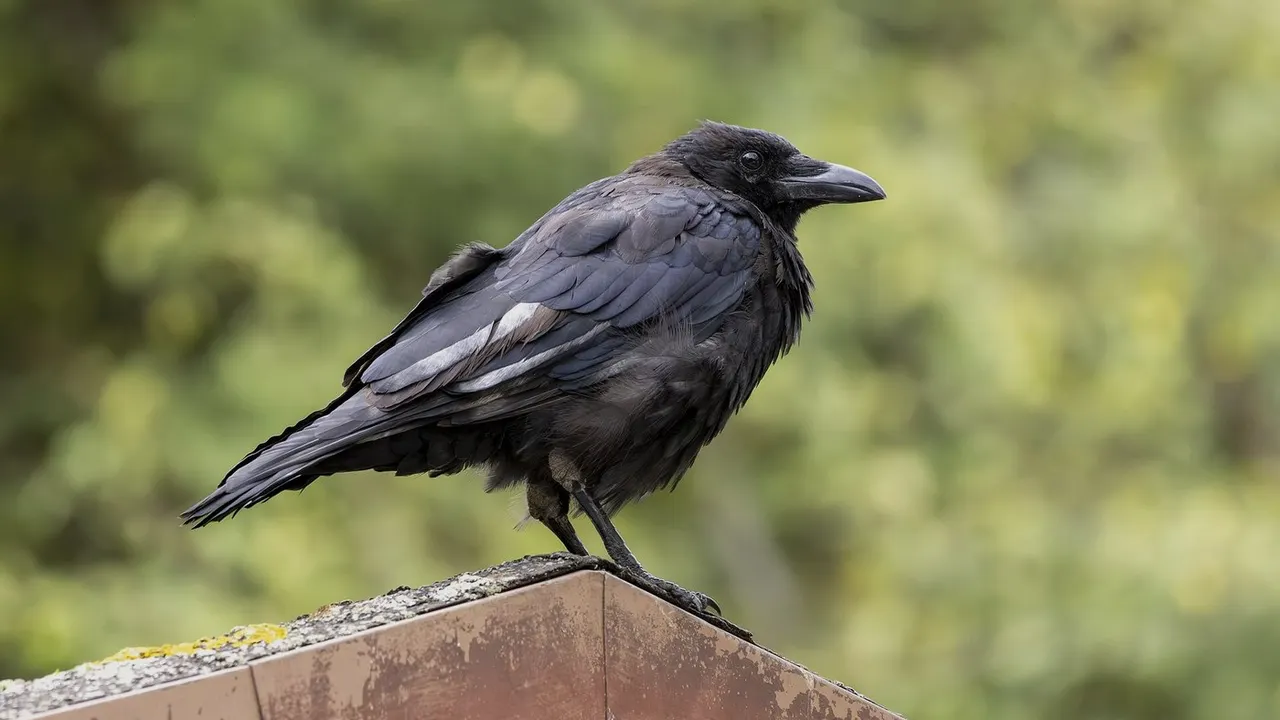
Carrion crows can make complex visual decisions in an average of 235 milliseconds, nearly twice as fast as the time recorded for humans and monkeys in identical tasks, according to a study published in Science on October 22, 2026.
At the Institute of Neurobiology at the University of Tübingen, researchers Philipp Schmidbauer and Andreas Nieder trained two hand-raised carrion crows to interact with a touch-sensitive screen. The birds were presented with a classic visual challenge: a field of white dots on a black background. While some dots moved in a coherent direction, others flickered randomly. The crows were rewarded with a mealworm for correctly identifying the direction of movement by pecking a target on the screen.
How fast can a crow's brain process information compared to primates?
The study found that carrion crows require less than a quarter of a second to process visual stimuli and initiate a response, whereas primates typically take roughly half a second for the same task. While the crows averaged 235 milliseconds, previous data from three similar monkey studies showed response times of approximately 410, 490, and 600 milliseconds. This speed is particularly notable because the crows were not under any time pressure; they were free to observe the screen for as long as they wished before deciding. Andreas Nieder suggests that the birds might be capable of even faster speeds if specifically incentivized for quickness.
Does the crow's decision speed lead to a reduction in accuracy?
Carrion crows do not sacrifice accuracy for speed, maintaining a high success rate even when visual information is extremely limited. Researchers tested this by varying the percentage of dots moving in the same direction from 81 percent down to a mere 3 percent, where movement is barely distinguishable from random noise. In primates, as a task becomes more difficult, the time taken to decide increases significantly. However, the crows showed only a minor delay, with their fastest decisions averaging 220 milliseconds and their most difficult ones averaging 254 milliseconds. This 34-millisecond difference indicates that while the birds do follow the same biological patterns as mammals—taking longer for harder choices—their baseline processing speed is fundamentally higher.
The "moving dots" test has been a staple of neuroscience since 1988, when William Newsome and Edmond Paré first used it to study motion perception in the monkey brain. By adapting this experiment for crows, the Tübingen team demonstrated that the avian brain, despite its different architecture, has evolved an exceptionally efficient system for accumulating evidence and reaching a conclusion. Even in conditions with no coherent movement where no correct answer existed, the birds' behavior remained consistent with a high-speed evidence-gathering process rather than random guessing.
Notes and Sources
- Schmidbauer, P., Nieder, A. (2026). "Ultrarapid decision-making in an avian brain". Science 394(6822): 445-449.
- Newsome, W. T., Paré, E. B. (1988). "A selective impairment of motion perception following lesions of the middle temporal visual area (MT)". The Journal of Neuroscience 8(6): 2201-2211.
- Roitman, J. D., Shadlen, M. N. (2002). "Response of neurons in the lateral intraparietal area during a combined visual discrimination reaction time task". The Journal of Neuroscience 22(21): 9475-9489.
- Palmer, J., Huk, A. C., Shadlen, M. N. (2005). "The effect of stimulus strength on the speed and accuracy of a perceptual decision". Journal of Vision 5(5): 1.
- Stacho, M. et al. (2020). "A cortex-like canonical circuit in the avian forebrain". Science 369(6511): eabc5534.
- Olkowicz, S. et al. (2016). "Birds have primate-like numbers of neurons in the forebrain". PNAS 113(26): 7255-7260.
- Poelstra, J. W. et al. (2014). "The genomic landscape underlying phenotypic integrity in the face of gene flow in crows". Science 344(6190): 1410-1414.
- University of Tübingen press release (October 22, 2026). "Crows decide twice as fast as humans and monkeys."